
By Ed Hotchkiss
Ed is a member of the New York Chapter and a published photographer on the New York Subway network.
Mali’s tourism used to attract hundreds of thousands of visitors annually, especially to Timbuktu and the Dogon Country. This dramatically declined in 2012 when weapons flowed into the country from Libya after the fall of Qaddafi and empowered Jihadist groups.
Bamako, the capital of Mali, is a gateway to learn about the country’s major ethnic groups and amazing culture. It’s reasonably secure, unlike the rest of Mali. We stayed four days last year which seemed to be the night amount of time. I recommend staying up to a week, if there is a festival.
Security
Before you go, please be sure to review the security situation and visa requirements.
Getting Around
A visitor doesn’t need a guide to see the main attractions in the city — inexpensive taxis can easily get you around. In the search for off-the-beaten-path places to take particular types of photos, we found Ahmed Ag Mohamed who provided invaluable assistance guiding us around.
There are alternative to taxis. Join residents in crowded private passenger vans, called Sotramas, with established routes but no timetables. If you are daring, ride through neighborhoods on the back of your guide’s motorcycle—an efficient way to weave through traffic. The most fun was walking the streets and talking with the locals especially street vendors, many of whom are mothers with babies on their backs.
Shopping
A visit to the Grand Marché, Bamako’s biggest market, offers everything you can imagine, including fruits, vegetables, meats, prepared food, clothes, household goods and handicrafts. In the N’glonina neighborhood, there are narrow streets of artists selling their works. At one stall, I had tea with Tuareg artists and looked at their jewelry, art pieces and antique items.
Museums
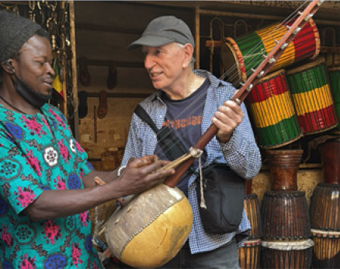
In the National Museum, there are three permanent exhibits on textiles, archaeological items and masks and statues. It had a special exhibition on the legendary Malian Desert Blues singer and multi-instrumentalist, Ali Farka Touré (1939 to 2006), with his instruments, clothing and even visas to foreign countries. There were also headphones to listen to his music. Check out his 1994 album with Ry Cooder, Talking Timbuktu. Mali has an exceptionally rich musical heritage; try to attend a couple of kora (a 21-string West African harp-lute) performances while there.
Places of Worship
The Grand Mosque was built on the site of a former pre-colonial, mud-brick mosque in the 1970s and funded by the Saudi Arabian government. It’s a much humbler structure than found in many other places in the Islamic World, constructed with concrete and an absence of architectural razzle-dazzle.
Sacred Heart Cathedral was finished in 1936. Until 1957, it was the only official place for Catholic worship in the city. The domes, high ceilings, and stained-glass windows are prominent features on the inside. Services are in English, French and Bambara, the primary language in the city. Christianity is a small minority religion (maybe 1% of the population) and was introduced in the country in the 19th century by French missionaries. Indigenous beliefs are still followed and often blended with Islam and Christianity.
Monuments
Some monuments are by government buildings and military installations that the police or soldiers
would not allow a pedestrian to photograph.
The Memorial for the March 22, 1991 Martyrs is homage to the victims of the 1991 coup d’état for democratic rule. At the bottom there’s a mother on her knees in tears, facing the body of her child who was shot.
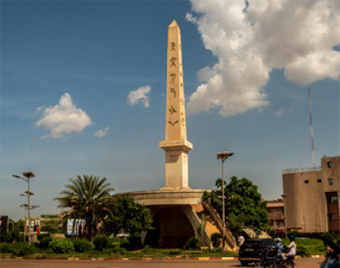
The Obelisk of Ideograms is dedicated to the N’Ko writing system that was developed in 1949 for Bambara and closely related languages. It’s used in Mali and other West African countries to provide a native script. It’s made up of 25 characters that are related to past written communications originating in Africa.
References
- Visit Ed’s website: https://exploringed.com/bamako-capital-and-gateway-to-mali. This article is only a snapshot of the amazing story and photographs taken by Ed.
- Reliable guide: Ahmed Ag Mohamed (WhatsApp +223 77 34 79 99)